mapQC#


A metric for the evaluation of single-cell query-to-reference mappings
Getting started#
Please refer to the documentation, in particular, the API documentation for detailed package documentation. For reproduction of the results in the paper, check out the mapQC reproducibility repository.
Below a few notes on how and when to use mapQC:
What does mapQC do?#
MapQC evaluates the quality of a query-to-reference mapping, and outputs a cell-level mapQC score for every query cell. MapQC scores higher than 2 indicate a large distance of the query cell to the reference. Given a healthy/control reference, we expect query controls to have low mapQC scores, and query case/disease cells to have higher mapQC scores in the case of case-specific cellular phenotypes. You can thus use mapQC scores to assess, in a quantitative manner, if your mapping was successful.
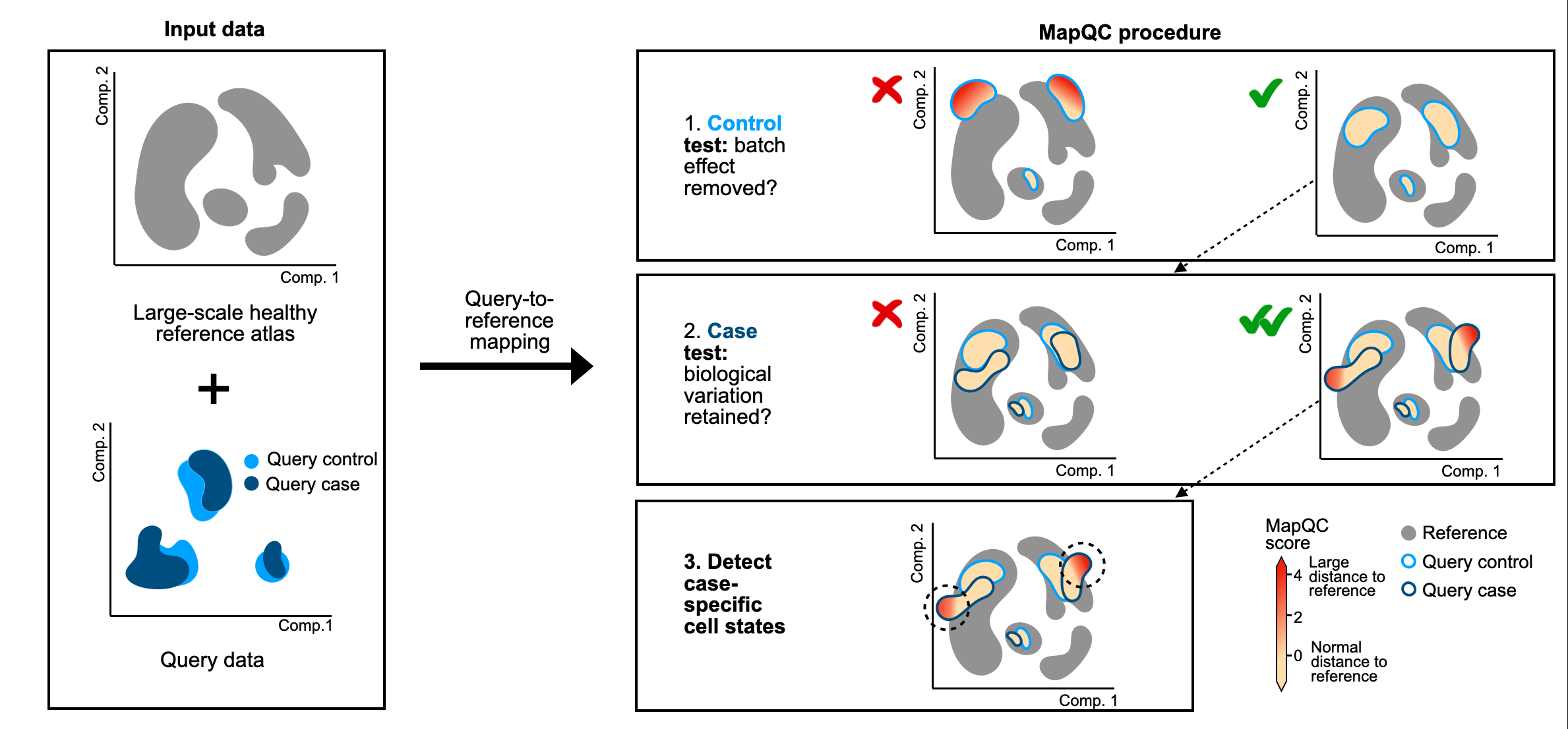
Overview of mapQC's workflow
What are the data requirements for using mapQC?#
In short, you need one AnnData object, including:
A large scale reference, including only its healthy/control cells.
A mapped query dataset, with healthy/control cells (must-have) and case/perturbed cells (if you have them).
Metadata (query/reference status, study, sample, and optionally clustering and cell type annotations)
A mapping-derived embedding including both the reference and the query
In the quick-start tutorial notebook we provide a more extensive description of the exact data requirements.
Installation#
You need to have Python 3.10 or newer installed on your system.
There are several alternative options to install mapQC:
Install the latest release of
mapqcfrom PyPI:
pip install mapqc
Install the latest development version:
pip install git+https://github.com/theislab/mapqc.git@main
Release notes#
See the changelog.
Contact#
I am happy to hear any comments, suggestions, or even bugs that you run into. I would like to make this package run as smoothly as possible! So for any of these, submit an issue on the mapQC GitHub page and I will be glad to help.
Citation#
Sikkema et al., bioRxiv 2025.